

September often reveals what may have gone unnoticed during the holidays: hair that feels rougher, looks less shiny, tangles more easily, has weakened ends or a colour that seems to have lost intensity. Sun exposure, frequent swimming, salt, chlorine, heat and manipulation create a particularly demanding environment for the hair fibre.
However, recovering hair after summer does not mean automatically choosing the most intensive treatment available. The first step is to identify which need is predominant: lack of conditioning and hydration, insufficient emollience, or a genuinely weakened fibre that requires a repairing routine.
What is a post-summer hair protocol? It is a cosmetic assessment of the condition of the hair followed by a tailored routine designed to improve hydration, softness, resistance, manageability and overall appearance after a period of increased environmental exposure. It does not replace a dermatological diagnosis when there are scalp problems or abnormal hair loss.
What happens to hair after summer?
The hair shaft is a keratinised structure whose outer surface, the cuticle, plays an essential role in feel, shine and resistance to friction. Research into the effects of ultraviolet radiation on the hair shaft describes how UV exposure can produce changes in the cuticle and cortex and contribute to structural and protein damage.
Repeated exposure to swimming pools and seawater adds another source of stress. Salt or chlorine residues, combined with drying, brushing, high temperatures and previous chemical services, can increase the sensation of roughness and make detangling more difficult.
The visible effect is not the same for every type of hair. Fine hair may lose movement if overloaded with formulas that are too rich, whereas bleached, porous or breakage-prone hair may need a more repairing approach. This is why it is useful to understand the difference between hair hydration, nourishment and reconstruction before building a routine.
How do you assess hair after summer?
In the salon, it is more accurate to speak of a cosmetic assessment of the hair fibre: a visual, tactile and technical evaluation designed to determine which type of care is most appropriate. The recent history of the hair is just as important as its current appearance.
- Review recent history: intense sun exposure, frequency of swimming in pools or the sea, bleaching, colouring, straightening, flat irons and blow-drying.
- Observe mid-lengths and ends: shine, uniformity, roughness, tangling, split ends and broken hairs.
- Assess manageability: observe how the fibre responds to detangling and whether gentle manipulation causes breakage.
- Consider density and thickness: a routine suitable for thick, highly sensitised hair may be too intensive for fine hair with moderate damage.
- Distinguish between hair and scalp: intense itching, lesions, persistent irritation or sudden hair loss require a different type of assessment.
Priority: hydration
Dryness, reduced flexibility, static or lack of softness are predominant, but the fibre retains reasonable strength and does not show significant breakage.
Priority: nourishment
The hair feels rough, frizzy or stiff and clearly needs greater emollience and conditioning, especially through the mid-lengths and ends.
Priority: repair
There is a history of chemical processing or intense wear together with porosity, fragility, breakage, reduced manageability or severely weathered ends.

Breakage and hair loss: two different situations
After summer, deterioration of the hair fibre may coincide with a greater perception of hair shedding, but these are different phenomena. Breakage affects the hair shaft: broken hairs, uneven lengths and weakened ends become visible. Hair loss or shedding involves hairs being released from the follicle and may have many causes that cannot be addressed with a repairing mask.
DermNet’s medical information on telogen effluvium describes it as a form of excessive shedding of resting or telogen hairs that may occur following different triggers. If hair loss is intense, appears suddenly, persists or is accompanied by scalp symptoms, dermatological assessment is appropriate.
Professional protocol to recover hair after summer
When the assessment indicates dry, weakened or stressed hair, the aim is not to accumulate products. Instead, the routine should combine cleansing, conditioning, protection and, when necessary, a more intensive repairing treatment.
- Cleansing adapted to the condition of the fibre Cleanse the scalp gently and avoid unnecessary friction through the mid-lengths and ends. For dry or damaged hair, Structure Repair Shampoo is designed by Kosswell as the first step in the repairing routine.
- Intensive conditioning After removing excess water, distribute Structure Repair Mask from mid-lengths to ends. The official product information recommends leaving it on for 5 to 10 minutes before rinsing thoroughly.
- Reduce friction and make styling easier On clean hair after removing excess water, apply Structure Repair Instant evenly from mid-lengths to ends and do not rinse. Easier detangling helps reduce repeated manipulation of already sensitised hair.
- Temporarily moderate heat stress Adjust the temperature and frequency of blow-dryers and heated styling tools. When the fibre is fragile, reducing further stress is just as important as conditioning it.
- Reassess before demanding chemical services Check strength, feel and the condition of the ends before carrying out further bleaching, straightening or another intensive technical service. If the hair is highly sensitised after summer, reducing additional stress while its condition is reassessed may be the more appropriate approach.
Repair according to what the hair actually needs
The Structure Repair range by Kosswell Professional is designed for dry, damaged, weakened or chemically treated hair. Within a post-summer protocol, it allows the professional or consumer to build a gradual routine instead of relying on a single product.
Structure Repair Shampoo
The official product information describes repairing, moisturising and conditioning agents. Its INCI includes, among other ingredients, glycerin, urea, amino acids and panthenol. Apply to wet hair, massage gently and rinse thoroughly. Repeat if necessary.
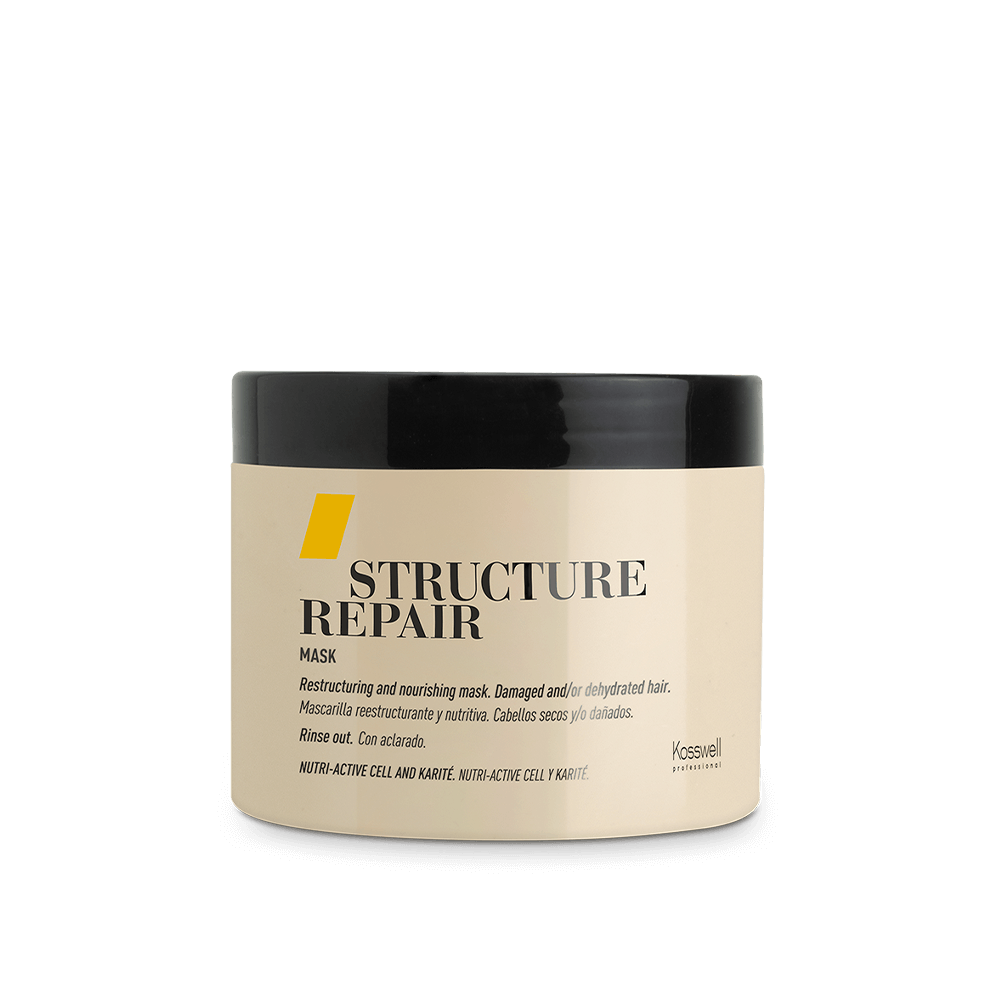
Structure Repair Mask
This intensive conditioning treatment contains, among other ingredients, shea butter, panthenol and conditioning agents. Apply to washed hair from mid-lengths to ends, leave on for 5 to 10 minutes and rinse thoroughly.
Structure Repair Instant
This leave-in conditioner contains hydrolysed vegetable protein, hydrolysed keratin, argan oil and panthenol among its ingredients. Kosswell positions it as a product designed to improve softness, manageability, elasticity and frizz control in weakened hair.
Product selection and frequency should be adapted to hair thickness, level of damage, washing routine and how the hair responds. Using more product or extending the processing time does not necessarily produce a better result.
When should an intensive salon treatment be incorporated?
If the fibre shows high porosity, intense dryness or a level of damage beyond what a regular home-care routine can reasonably address, the professional may consider Two Steps Repair. Kosswell describes it as an intensive two-phase treatment formulated with hyaluronic acid for porous, dry or severely damaged hair.
The official protocol involves combining both phases in a non-metallic bowl until a homogeneous emulsion is obtained, applying it to clean hair divided into four sections, leaving it on for 10 minutes, rinsing thoroughly and proceeding with blow-dry styling. This step does not need to be included automatically: it should be reserved for hair whose cosmetic assessment justifies a more intensive approach.
“Repair” in hair cosmetics does not mean biologically regenerating the hair shaft. Visible hair is a keratinised fibre. Cosmetic products can condition, coat, lubricate and temporarily improve its resistance, feel and appearance, but a physically split end cannot be permanently rejoined. When the ends are severely damaged, trimming remains part of the strategy. Kosswell’s guide to hydration, nourishment and reconstruction explains how to differentiate these cosmetic needs.
Frequently asked questions about post-summer hair recovery
How do I know whether my hair needs hydration or repair?
Dryness or lack of softness alone does not necessarily indicate significant structural damage. If there is also breakage, marked porosity, reduced resistance and a history of bleaching, straightening or intense stress, a repairing routine may be more appropriate. Fine hair with little fragility should not be unnecessarily overloaded.
Do I need to cut my hair after summer?
Not automatically. Trimming is particularly useful when the ends are split, severely thinned or physically deteriorated, as this type of structural damage cannot be permanently reversed with a cosmetic product. The amount that needs to be removed depends on the condition of the individual hair.
How long should Structure Repair Mask be left on?
Kosswell’s current official instructions recommend applying Structure Repair Mask to washed hair after removing excess water, distributing it evenly from mid-lengths to ends, leaving it on for 5 to 10 minutes and rinsing thoroughly.
Can hair be coloured or bleached immediately after summer?
It depends on its condition. When there is significant fragility, severely damaged ends or a highly sensitised fibre, the professional should assess its resistance before adding another chemical process. Temporarily postponing a demanding service may be preferable to increasing accumulated stress.
Can repairing products solve increased hair shedding in autumn?
Not necessarily. Repairing products work on the cosmetic condition of the hair shaft, whereas increased shedding may be related to the hair growth cycle or other causes. If shedding is intense, sudden, persistent or accompanied by scalp symptoms, consultation with a dermatologist is recommended.
How long does it take for hair to recover?
There is no universal timeframe. Feel, shine and manageability may improve with appropriate conditioning, but the degree of visible recovery depends on previous damage, thickness, chemical processing and subsequent habits. Severely damaged hair may require a combination of cosmetic treatment, reduced exposure to further stress and progressive trimming of damaged ends.
Restore balance before placing new demands on the hair
A good post-summer hair protocol is not about masking damage with an immediate solution. It is about correctly interpreting the condition of the fibre, adjusting the balance between hydration, nourishment and repair, and temporarily reducing the factors that continue to weaken it.
Structure Repair makes it possible to build this recovery progressively through cleansing, intensive conditioning and leave-in care, while Two Steps Repair provides a more intensive professional option when porosity and fragility justify it. The most coherent result always starts with the same decision: treating what the hair actually needs, rather than what it appears to need at first glance.
Turn the end of summer into a new starting point
Discover the Structure Repair routine by Kosswell Professional or contact the professional team to find the most appropriate care strategy for each type of hair.